






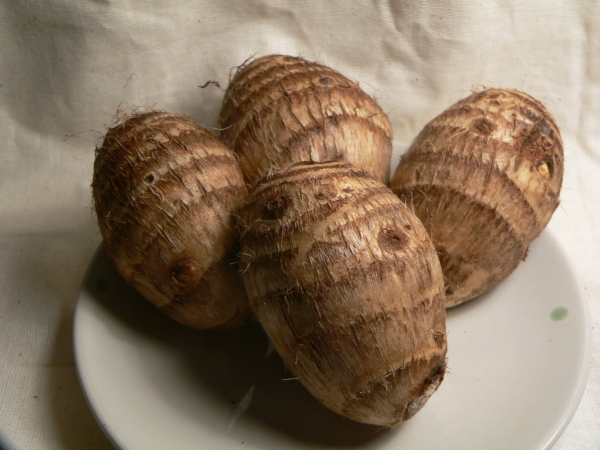
(1/1) Japanese Taro By Yongxinge [GNU 1.2, _version_1.2), CC BY-SA 3.0] (Photo Credits)
Taro
CategoryTaro is a staple crops of the Pacific Islands and is also very popular throughout many parts of Asia. The delicious tuber can substitute potato in almost any dish, baked, boiled or made into chips. Its very ornamental heart-shaped leaves make a great spin... Read More
Taro Pacific
$17.90
A large tuber, sometimes reaching up to 3-4 kg. Taro a staple crops of the Pacific. The delicious tuber can substitute potato in almost any dish. Its heart-shaped leaves make for an attractive ornamental plant that grows well in both shade and sun. Prefers moist soil.Taro should never be eaten raw, due to the presence of harmful oxalates, which are eliminated with cooking. These substances are particularly high in the leaves. Weed Warning: in tropical areas, Taro can spread overtime especially in waterways, displacing native vegetation. Plant responsibly

Taro Japanese
$17.90 ($17.90-$18.75 choose a size)
A staple crop throughout Asia and the Pacific. The delicious small tuber can substitute potato in almost any dish. Its heart-shaped leaves make for an attractive plant that grows well in shade and sun. Prefers moist soil.Taro should never be eaten raw, due to the presence of harmful oxalates, which are eliminated with cooking. These substances are particularly high in the leaves. Weed Warning: in tropical areas, Taro can spread overtime especially in waterways, displacing native vegetation. Plant responsibly


Click Choose above to view Specials
Popular in Category: Taro
Taro Pacific
$17.90
A large tuber, sometimes reaching up to 3-4 kg. Taro a staple crops of the Pacific. The delicious tuber can substitute potato in almost any dish. Its heart-shaped leaves make for an attractive ornamental plant that grows well in both shade and sun. Prefers moist soil.Taro should never be eaten raw, due to the presence of harmful oxalates, which are eliminated with cooking. These substances are particularly high in the leaves. Weed Warning: in tropical areas, Taro can spread overtime especially in waterways, displacing native vegetation. Plant responsibly
Taro Japanese
$17.90 ($17.90-$18.75 choose a size)
A staple crop throughout Asia and the Pacific. The delicious small tuber can substitute potato in almost any dish. Its heart-shaped leaves make for an attractive plant that grows well in shade and sun. Prefers moist soil.Taro should never be eaten raw, due to the presence of harmful oxalates, which are eliminated with cooking. These substances are particularly high in the leaves. Weed Warning: in tropical areas, Taro can spread overtime especially in waterways, displacing native vegetation. Plant responsibly
Click Choose above to view Specials
Customer Tips & Reviews Taro
person_outline
Taro
I found the Pacific taro gave quite a poor return for 9 months of vigorous growth. The smaller varieties seem to offer much better value unless space and water are not a concern.
person_outline
Boya, WA, Australia, Australia
Taro
Taro grown in a large fishpond is relished by koi. Plant against pond side and cover with rocks, fish eat the emerging roots and it adds to the eco system.Float polystyrene foam boxes full of water loving edible plants in the pond.