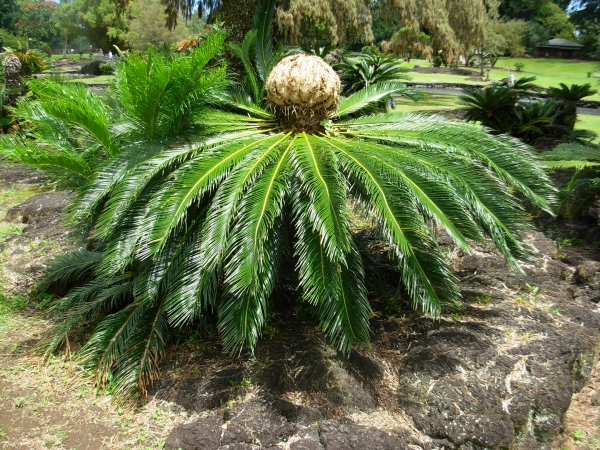








Female Sago Palm with fruits below the new growth

(1/6) Female Sago Palm with fruits below the new growth

Sago Palm with Male cone

(2/6) Sago Palm with Male cone

Cycas Revoluta Sago Cycad

(3/6) Cycas Revoluta Sago Cycad By J Brew [CC BY-SA 2.0] (Photo Credits)

Center of Cycad rosette and new growth tip

(4/6) Center of Cycad rosette and new growth tip

A mass planting of Cycads for impressive effect

(5/6) A mass planting of Cycads for impressive effect

Cycad - Sago Palm For Sale

(6/6) Cycad - Sago Palm For Sale

fullscreen1

Cycad - Sago Palm

Cycas revoluta
This very symmetrical plant supports a crown of shiny, dark green leaves on a thick shaggy trunk that is typically about 20cm in diameter, sometimes wider. The trunk is very low to subterranean in young plants, but lengthens above ground with age. It can ... Read More

$31.95

Specifications of Cycad - Sago Palm

Preferred Climate Tropical, SubtropicalLearn About Climate Zones

Grown From SeedlingLearn About Propagation Methods

Max Height (when in the ground with good conditions) 0-1m

Plants required to Pollinate 3 Plants (Male and Female)Learn about Pollination

Can it Handle Frosts? Sometimes

Amount of leaves in Winter? All Leaves (Evergreen)

Water Requirements Drought Hardy (Little Watering)

Time to Fruit/Flower/Harvest 4-5 Years

Sun or Shade Full (Sun:80%-100%)

Preferred Soil Type Good Drainage

Soil pH Neutral (6.6-7.3pH)

Fruiting/Harvest Months February, March

Customers also bought

These plants are often purchased together. Also check plant information for suitability in your orchard.

Canistel - Grey

$79.00

Canistel Grey is a large elongated variety with a unique shape, ripening in late winter/Spring in the subtropics. Canistels are best eaten when they are at their optimum ripeness to achieve a creamy consistency and a sweet custard flavour. Their flowers are formed on their branches, a feature called cauliflory, enabling them to be pruned to keep them small. They tolerate the subtropics quite well.

Cassava - Yellow

$21.00

The tuberous root is light yellow and flavour is richer than the white, tasting a lot like potato. This is the sweet variety producing smaller but more nutritious tubers. Harvest can start from earlier than 12 months. Tubers are best dug when small and used within a couple of days or stored in the ground on the plant.Cassava is a shrubby plant growing to about 1-3m, with thin stems and attractive large palm-shaped leaves. A perennial shrub cassava produces a high yield of tuberous roots in 6 months to 3 years after planting. The tubers are the main part that is eaten, but the leaves can be enjoyed as a vegetable dish. Cassava is an important daily source of starch for 300-600 million of the poorest people around the world. It is among the most productive uses of subsistence land, producing 40% more starch than rice, and 25% more than maize. Note that all cassava is poisonous!! In some bitter varieties, all parts of the plant are laced with a highly toxic poison (hydrocyanic or prussic acid). Sweet varieties have lower or marginal concentrations of the toxin. But the more toxic varieties produce bigger tubers! Plants from the tropics have evolved toxins as a defence against predators more so than those from temperate climates which is why they require cooking in order to eat them. Thorough cooking dispels or denatures the harmful toxins, and makes the remaining portion safe to eat. Powdered cassava is treated like a flour and made into cakes, unleavened bread, pasta, crackers. Sliced cassava is also made into crisps. Flat bread made from cassava meal can keep for a year without spoiling. Dried chips or pellets are used as animal feed. Young tender leaves are rich in Vitamin B and protein, but also has more of the toxins. They are eaten as a vegetable. Like the tubers, they have to be boiled for minimum 15-20 mins in an open topped vessel to remove their toxins.Best grown without the use of fertilisers as too much vegetative growth is promoted at the expense of tubers
  Special  

Muscadine Grape - Noble

$19.90 ($17.75-$79.00 choose a size)

Most popular red muscadine grape for wine or juice production. It is self-fertile. Yields and disease resistance are high, and berry ripening is fairly uniform. Flavour is less musky than most muscadine grapes. Excellent fresh eating or good for wine making. Exclusive to Daleys this is a recently released Florida variety. They are vigorous vines and should not be planted where they can escape into native bushland, as they would quickly smother trees and shrubs around them.
Buy 1+ @$19.90ea usually:$24.00ea

Taro Japanese

$17.90 ($17.90-$18.75 choose a size)

A staple crop throughout Asia and the Pacific. The delicious small tuber can substitute potato in almost any dish. Its heart-shaped leaves make for an attractive plant that grows well in shade and sun. Prefers moist soil.Taro should never be eaten raw, due to the presence of harmful oxalates, which are eliminated with cooking. These substances are particularly high in the leaves. Weed Warning: in tropical areas, Taro can spread overtime especially in waterways, displacing native vegetation. Plant responsibly
Click Choose above to view Specials

Panama Berry

$24.00 ($7.90-$79.00 choose a size)

A highly ornamental tree that bears small red berries within its first year. Blossoming and producing all year round, the flowers are white and followed by small red fruit that is sweet with the taste of caramel. The trees are exceptionally attractive with long spreading branches that often droop down to the ground and soft weeping foliage. Trees are very fast growing and drought hardy once established. They can grow 5-10m in ideal conditions but respond well to being cut back so it is possible to keep them smaller than this making it easier to browse on the tempting little fruits. Panama berries will happily grow and fruit in large containers provided they have a good quality mix and a healthy layer of organic mulch to hold the moisture in. It is the ideal backyard tree if you have children as it is a lovely little shade tree as well as producing tempting little sweet treats. Used fresh or in jams.Weed Warning: Panama Berry is regarded as an environmental weed in northern Queensland and on Christmas Island.
Click Choose above to view Specials
  Special  

Nangapire

$17.90 ($2.95-$29.00 choose a size)

A South American Eugenia, sweet tasty fruit similar to the Rio Grande Cherry. Self pollinating selection. Makes an attractive fruit bearing hedge.Weed warning: Nangapire is not listed as a weed in NSW or Qld but it has the potential to be spread by birds as it self seeds readily. Please net your plants
Click Choose above to view Specials

Cycad - Sago Palm Reviews & Tips

Star Rating

Emma1
★★ 15y ago

Bardon, Qld, Australia

Big old looking plant-thing. Leaves are tatty, being attacked by cycad moth. I have one large and very two small plants.


  • Subscribe
  • Postage Free Truck
  • Plant List
  • Calculate Freight