







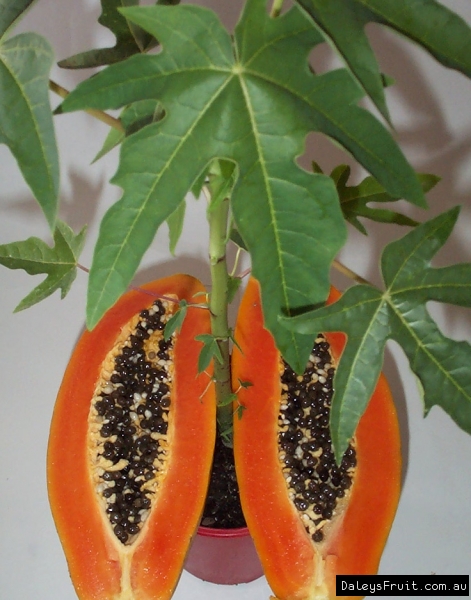
(1/11) Papaya Southern Red

(2/11) Paw Paw Southern Red Cutting Grown Tree

(3/11) Paw Paw Southern Red Tree

(4/11) Paw Paw Southern Red mature

(5/11) Ripening on the southern red papaya plant being grown by our staff member Andre

(6/11) How to identify bisexual pawpaw flowers

(7/11) Pollination of the Bisexual Southern Red Pawpaw

(8/11) Potted Paw Paws

(9/11) Leaf of the Pawpaw Southern Red

(10/11) Papaya - Southern Red For Sale

(11/11) Papaya - Southern Red For Sale
Papaya - Southern Red
Carica papaya$19.75 ($4.90-$19.75 choose a size)
When will it be in Stock?
We previously had the most to buy in Feb and Jan. With limited quantities for sale in other months. They are unlikely to be available in Dec. Special Note: This plant is in the top 25% of plants customers are wanting to know about. It is very unlikely that you will be able to purchase this plant unless you click above to be notified when it is in stock again. Please expect a delay on this item as we notify those who have waited the longest .
Specifications of Papaya - Southern Red
Preferred Climate Tropical, SubtropicalLearn About Climate Zones
Grown From SeedlingLearn About Propagation Methods
Max Height (when in the ground with good conditions) 2-3m
Plants required to Pollinate 1 (Self Pollinating)Learn about Pollination
Can it Handle Frosts? Likes Temps above 5deg
Amount of leaves in Winter? All Leaves (Evergreen)
Quarantine Restrictions to these Areas WA
Water Requirements Frequent Watering
Is it a Dwarf Fruit Tree? No (Full Size)
Time to Fruit/Flower/Harvest 2-3 Years
Sun or Shade Full (Sun:80%-100%), Part (Sun:50-80%)
Preferred Soil Type Perfect Drainage (Sand/Volcanic)
Soil pH Neutral (6.6-7.3pH)
Fruiting/Harvest Months February, March, April, May, June, October, November, December
Create a Filter to find similar plants
Customers also bought
These plants are often purchased together. Also check plant information for suitability in your orchard.
Exclusion Net - 6m x 6m
$54.00 ($54.00-$59.00 choose a size)
Maple - Japanese
$19.75 ($19.75-$49.00 choose a size)

Rosella
$11.75 ($4.90-$17.75 choose a size)


Malabar Chestnut
$14.90 ($14.90-$59.00 choose a size)


Green Globe Artichoke
$12.90 ($7.75-$14.90 choose a size)

A. Australian Fruit and Edible Plant Resource
$5.00
Customer Tips & Reviews Papaya - Southern Red
Papaya - Southern Red
I have had this tree for at least 6 years now & its a prolific bearer of delicious fruit. Its in Coolum Beach.
Papaya - Southern Red
We are growing the Southern Red in Adelaide and nearly lost it in the first winter but it recovered and this past winter we put 3 posts around it and wrapped bubble wrap around the outside of the 3 posts as insulation, is now growing beautifully.

(1/2)

(2/2)
RIVERTON, WA, Australia
This papaya is one of many seedlings I got from a friend. They have been very productive trees and have great tasting fruit that don%u2019t have a musky flavour.
Eastwood, Sydney, NSW, Australia
Papaya - Southern Red
I live in Sydney, my 4mth old plant is fruiting. A neighbour also has this plant, they have 10+ fruit. Another neighbour has this plant, no fruit. Their plants are over 1year old so it should survive over winter.
EASTWOOD, NSW, Australia
We had a very hot spell when I received the plant (over 30C most days, over 40C some days) and it required daily watering. Due to the extreme heat it would wilt every evening. We also had some fierce winds which damaged quite a lot of leaves. The plant...
Pawpaw - Southern Red
Plant tomato around your young pawpaw trees in autumn in Sydney. So when winter comes, your pawpaws are protected from cold. Then have tomatoes in spring and remove the stalks. This will make a huge difference to the survival rate of your young pawpaws.
CARINDALE, QLD
Pawpaw is great any time. I shall head prune it at about 1.5 metres to force branchesJune 2016. turned out to be a maleDec 2017 Quite a large crop of small but very tasty fruit. The tree turned out to be bi. Lopped to head height earlier thi...

(1/4)

(2/4)

(3/4)

(4/4)
Moun-druitt, NSW, Australia, Australia
Pawpaw - Southern Red
Hope it will succeed in Sydney North west looking after it from frost
Inala, QLD, Australia
Quick, productive, healthy enzymatic fruit. The scent of the flower converted me to the fruit. The red is my favourite, and I've planted a lime just to go with the papaya. The lime enhances the sweetness and neutralises the smell that used to repulse m...

(1/1)
Unanderra, NSW, Australia
Very fast growing, tropical looking. I have most of my paw paws growing on the east side of my house to protect them from the cold westerly winds that prevail here in Wollongong - seems to help. Fruits taste way better than anything from the superm...
sydney, nsw, australia
very good looking plant small flower buds growing in large terracotta pot
Eatons Hll, QLD
Pawpaw - Southern Red
We have our Southern Red Bisexual against a north facing wall and it is huge. Standing nearly 4m high with 4 offshoot branches all bearing fruit making it look more like a bush! In the summer we are getting 5 ripe fruits a week - fantastic!
Holsworthy, NSW, Australia
Grew very well all spring, summer and autumn. Lost all leaves to frost. One small new leaf still survives. I am confident this will continue to grow come spring. Died this winter due to frost damage.Want to know if there is a frost tolerant variety
Goodna, QLD, Australia
purchased 2. Only 1 has provided fruit the other appears to have male flowers only. Fruit taste great.

(1/3)

(2/3)

(3/3)
Kundabung, NSW, Australia
Ok well i got these paw paws from dales in late to early october 08. I planted them in the ground in late novermber. They are 6-7 feet tall now and goin strong apart from all the rain we had. I built up some soil next to my green house on the north fa...