







Eastgardens Fruit Trees (Popular)
Eastgardens Fruit Trees and the most popular plants Australians buy for mail order. With fruit trees you should consider climate suitability.
Peach - Tasty Zee
$59.00 ($59.00-$69.00 choose a size)
An attractive, white-fleshed peach with excellent quality. Produces commercial grade peaches that are very sweet, firm and juicy, freestone. Used for fresh fruit and drying. Late-season maturity. Tree grows 4 x 4m

(Discontinued) Native Raspberry - Peter's Thornless PBR
$29.00 ($27.00-$29.00 choose a size)
(Discontinued) Take a walk along forest margins or your local creek in eastern Australia, and you will come across Native Raspberries. This cultivar however is completely Thornless, and was selected by local Peter Hardwick. Being completely thornless, it is a pleasure to pick the fruit from its scrambling branches. Berries are bright red, sweet and juicy when well watered and grown with plenty of organic matter. The canes can produce fruit in as little as 6 months and respond well to fertiliser, compost and mulch. Vigorous and scrambling to 1.5m, with a suckering habit which is easily controlled with mowing, the plant is best staked to keep the fruit off the ground and keep it tidy. The leaves of native raspberry can also be used in tea and skin care products. A tea can be made from an infusion for 15 mins from up to six shoots of fresh native raspberry leaf in a teapot. The leaf can also be used as a dried herb. The flavour of the leaf is mildly herbaceous and astringent. It mixes well with other native teas like lemon myrtle and cinnamon myrtle. Research on the leaf of native raspberry shows that it contains beneficial plant compounds like pomolic acid, euscaphic acid, gallic acid and ellagic acid. This plant has Plant Breeder Rights and is not permitted to be propagated and sold for a commercial purpose.


Wampee - Guy Sam
$49.00 ($49.00-$79.00 choose a size)
This grafted variety has a sweet tangy aromatic flavour. Wampees are a handsome foliage evergreen tree grown for Summer ripe fruit with grape like flesh that hang in bunches. When grown on its own the fruit is seedless. Excellent tree for the subtropics and can be kept under 3 metres with pruning.

Bilimbi
$34.00 ($29.00-$79.00 choose a size)
The fruit is crisp when unripe, turns from bright green to yellow-green, ivory or nearly white when ripe and falls to the ground. The skin is glossy, thin, soft and tender, and the green flesh is jelly-like, juicy and extremely acid. They are sometimes faintly five-angled with an acid pulp. The bilimbi is a close relative to the carambola however it is quite different in its appearance, manner of fruiting and uses. Originating and grown extensively in Indonesia it is also cultivated and semi-wild everywhere in the Philippines and is very common in , Ceylon, Burma, Thailand, Malaya and Singapore. The mature fruits have a crunchy watery flesh and resemble small cucumbers. They usually range from 5 to 8cm in length. The fruits are picked by hand, singly or in clusters. They need gentle handling because of the thin skin and cannot be kept for more than 4 to 5 days. The fruit is generally regarded as too acid for eating raw, but in Costa Rica, the green, uncooked fruits are prepared as a relish that is served with rice and beans. Sometimes it is an accompaniment for fish and meat. Ripe fruits are frequently added to curries in the Far East. Bilimbi is often used in place of mango to make chutney. To reduce acidity, it may be first pricked and soaked in water overnight, or soaked in salted water for a shorter time; then boiled with sugar to make a delicious jam. Half-ripe fruits are salted, set out in the sun, and pickled in brine. An attractive and medium sized tree the bilimbi displays attractive dark-red flowers that are produced in panicles from the trunk and older branches. A tropical species the bilimbi is more cold sensitive than the carambola especially when very young. It will be a challenge trying to grow outside the Tropics. It does best in rich, moist, but well-drained soil, it grows and fruits quite well on sand or limestone. No pests or diseases have been reported specifically for the bilimbi.

Soursop
$34.00 ($17.75-$49.00 choose a size)
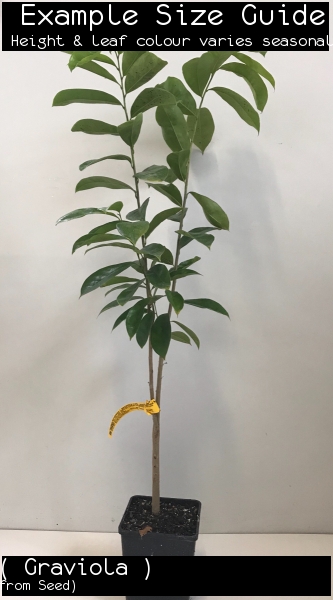
The fruit is heart-shaped with a rough green skin and soft fleshy spines. The fresh meaty flesh is juicy and slightly acid producing a rich creamy thirst quenching juice. Superb when fruit is pureed with 1/3 of vanilla ice-cream. Also known as Graviola or Guanaban. Not suitable for temperate climates. But it's more than just a sweet treat.

pin_drop