







Middle Pocket Fruit Trees (Popular)
Middle Pocket Fruit Trees and the most popular plants Australians buy for mail order. With fruit trees you should consider climate suitability.
Lychee - Salathiel
$59.00 ($59.00-$79.00 choose a size)
Tree has an open dome shape with excellent quality fruit. Well suited to subtropical conditions. Beautiful coloured fruit with very small seed. Needs protection from wind when young. Mid season

Special
Sudachi - Grafted
$34.00
As well known as the Yuzu in Japan where this sour citrus originates it is considered an indispensable companion to eating matsutake mushroom. The freshly squeezed juice is used as an alternative to vinegar. Fruits form in tight clusters and are harvested when still green in Autumn although they do turn yellow-orange when fully ripe. Commonly used as a garnish the aroma is zestier than lemons or limes. This variety has some cold sensitivity and is best grown in sub-tropical to tropical areas.

Buy 1+ @$34.00ea usually:$44.00ea
Cassava
$19.75 ($7.90-$19.75 choose a size)
The tuberous root is white and has a satisfying but bland taste. Harvest can start from earlier than 12 months. Tubers are best dug when small and used within a couple of days or stored in the ground on the plant.Cassava is a shrubby plant growing to about 1-3m, with thin stems and attractive large palm-shaped leaves. A perennial shrub cassava produces a high yield of tuberous roots in 6 months to 3 years after planting. The tubers are the main part that is eaten, but the leaves can be enjoyed as a vegetable dish. Cassava is an important daily source of starch for 300-600 million of the poorest people around the world. It is among the most productive uses of subsistence land, producing 40% more starch than rice, and 25% more than maize. Note that all cassava is poisonous!! In some bitter varieties, all parts of the plant are laced with a highly toxic poison (hydrocyanic or prussic acid). Sweet varieties have lower or marginal concentrations of the toxin. But the more toxic varieties produce bigger tubers! Plants from the tropics have evolved toxins as a defence against predators more so than those from temperate climates which is why they require cooking in order to eat them. Thorough cooking dispels or denatures the harmful toxins, and makes the remaining portion safe to eat. Powdered cassava is treated like a flour and made into cakes, unleavened bread, pasta, crackers. Sliced cassava is also made into crisps. Flat bread made from cassava meal can keep for a year without spoiling. Dried chips or pellets are used as animal feed. Young tender leaves are rich in Vitamin B and protein, but also has more of the toxins. They are eaten as a vegetable. Like the tubers, they have to be boiled for minimum 15-20 mins in an open topped vessel to remove their toxins.Best grown without the use of fertilisers as too much vegetative growth is promoted at the expense of tubers


Chestnut - Reilly
$49.00 ($49.00-$79.00 choose a size)
The Reilly originates from a planting made early this century on the Alstonville Plateau. A low chill variety that bears prolifically in Feb/March. Fair nut and keeping qualities.

Special
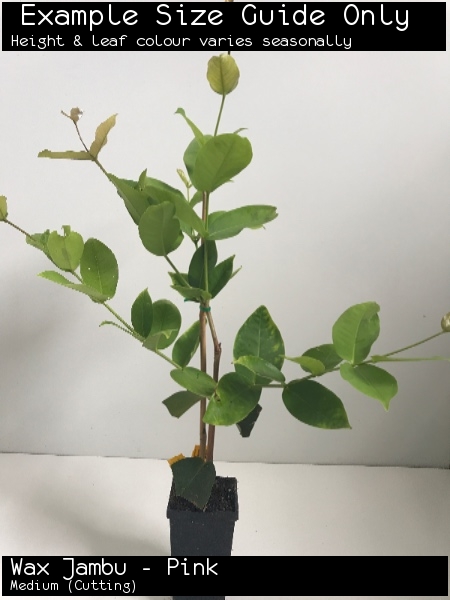
Wax Jambu - Pink
$34.00 ($29.00-$99.00 choose a size)
Fast growing tree, attractive pink pear shaped fruit that are crunchy and refreshing on a hot summers day. Grows and crops well here in the subtropics as long as they are protected from frosts when young. They generally don't have seeds but may on rare occasions, depending on pollination.



Buy 2+ @$34.00ea usually:$49.00ea
pin_drop
This Postcode: 2483
place Ocean Shores Fruit Trees place Crabbes Creek Fruit Trees place Brunswick Heads Fruit Trees place Burringbar Fruit Trees place Billinudgel Fruit Trees place The Pocket (nsw) Fruit Trees place South Golden Beach Fruit Trees place Upper Burringbar Fruit Trees place New Brighton Fruit Trees place Middle Pocket Fruit Trees place Yelgun Fruit Trees place Mooball Fruit Trees place Sleepy Hollow Fruit Trees place Fairlight Fruit Trees place Wooyung Fruit Trees place THE POCKET Fruit Treespin_drop
Previous Postcode: 2482
place Mullumbimby Fruit Trees place Goonengerry Fruit Trees place Main Arm Fruit Trees place Wilsons Creek Fruit Trees place Mullumbimby Creek Fruit Trees place Upper Main Arm Fruit Trees place Wanganui Fruit Trees place Upper Wilsons Creek Fruit Trees place Huonbrook Fruit Trees place Upper Coopers Creek Fruit Trees place Montecollum Fruit Trees place Myocum Fruit Trees place Palmwoods Fruit Treespin_drop